Team

29.04.2025 Unlocking Unconventional Magnetism for IT Devices in Germany

Jairo Sinova to coordinate a new Priority Program for fundamental and applied research into information technology based on altermagnetism.

Professor Jairo Sinova of Johannes Gutenberg University Mainz (JGU) will be coordinating a new Priority Program in the field of condensed matter physics that will be dealing with unconventional magnetism. The Priority Program will involve fundamental and applied research in the field of unconventional magnetic systems to develop IT components or devices that will reach the technical limits of physical viability in terms of speed, storage density, and efficiency. The German Research Foundation (DFG) has approved the establishment of the Priority Program on “Unconventional Magnetism: Beyond the s-wave magnetism paradigm” and will be providing around EUR 8 million in funding over an initial period of three years. The project is to be launched in 2026.

You can find the press release under Innoreports.
Posted on | Posted in Team

08.11.2024 Tobias Wagner succesfully defends his PhD thesis

We congratulate our colleague Tobias Wagner, who successfully defended his PhD on "Interface Effects in Antiferromagnetic-Ferromagnetic Hybrid Systems".  He there studied how domains, topological structures and dynamics are connected in systems of antiferromagnets and ferromagnets grown on each other. His work lead to multiple publications, namely

Imprinting of Antiferromagnetic Vortex States in NiO-Fe Nanostructures

Revealing the ultra-fast domain wall motion in Mn2Au through permalloy capping

Coupling of ferromagnetic and antiferromagnetic spin dynamics in Mn2Au/NiFe thin-film bilayers.

Posted on | Posted in Team

Atasi Chakraborty

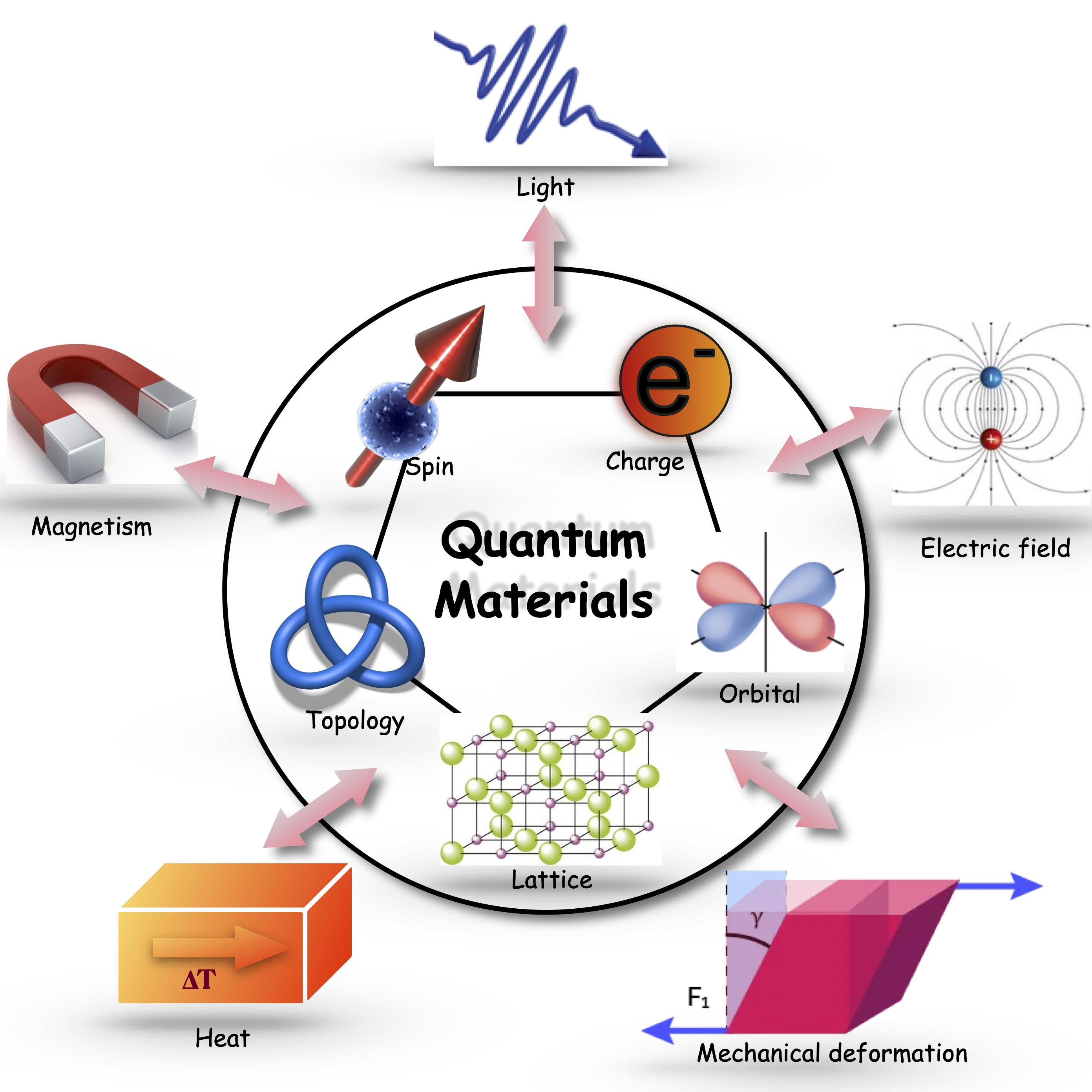
Understanding the electronic structure of solids plays a pivotal role in exploring the fascinating physical properties of quantum materials and their potential technological applications. My research focuses on comprehending the emergence of a plethora of exotic properties resulting from the intricate interplay between various factors: the kinetic energy of electrons governed by the band-width (W), Coulomb repulsion (U), spin-orbit coupling (SOC) strength (λ), and lattice degrees of freedom. To achieve this, I employ two complementary theoretical approaches: the state-of-the-art density functional theory (DFT) and low-energy model Hamiltonians. Furthermore, I am deeply intrigued by the transformations of physical properties of anti-ferro- and altermagnets in the presence of external perturbations, such as mechanical deformations, magnetic or electric fields, heat, and light. This area currently constitutes a significant focus of my research, promising exciting prospects for advancing our understanding of quantum materials and their practical applications.

Posted on

Venkata Krishna Bharadwaj

Data has become the new oil today, with their increasing demands for faster, denser, non-volatile, and low-power-consuming technologies. In this context, spintronics, which employs both charge and spin degrees of freedom, has provided some novel concepts to further state of art in this regard. Magnetic skyrmion being the new protagonist in the arena, has attracted a lot of research interest over the last decade, owing to their topological robustness and very low currents to manipulate them.

My research focuses on magnetic skyrmioms in in-plane ferromagnets and synthetic antiferromagnetic (SAF). Recently, we have studied the stability of in-plane skyrmions in collinear ferromagnets and in-plane SAFs. We have also looked at current-driven dynamics and external field-induced excitations of these in-plane skyrmions. We use both analytical and micromagnetic simulations in our research.


Publications


Arxiv

'Strain control of band topology and surface states in antiferromagnetic EuCd2As2'.Nayra A Álvarez Pari, VK Bharadwaj, R Jaeschke-Ubiergo, A Valadkhani, Roser Valentí, L Šmejkal, Jairo Sinova (2023)

Arxiv

'Direct observation of altermagnetic band splitting in CrSb thin films'. Sonka Reimers, Lukas Odenbreit, Libor Smejkal, Vladimir N Strocov, Procopios Constantinou, Anna Birk Hellenes, Rodrigo Jaeschke Ubiergo, Warlley H Campos, Venkata Krishna Bharadwaj, Atasi Chakraborty, Thiboud Denneulin, Wen Shi, Rafal E Dunin-Borkowski, Suvadip Das, Mathias Kläui, Jairo Sinova, Martin Jourdan (2023)

Arxiv

'Supercell Altermagnets'. R. Jaeschke-Ubiergo, V.K. Bharadwaj, L. Šmejkal, Jairo Sinova (2023)

Arxiv

'Homochiral antiferromagnetic merons, antimerons and bimerons realized in synthetic antiferromagnets'. Mona Bhukta, Takaaki Dohi, Venkata Krishna Bharadwaj, Ricardo Zarzuela, Maria-Andromachi Syskaki, Michael Foerster, Miguel Angel Niño, Jairo Sinova, Robert Frömter, Mathias Kläui . (2023)

Physical Review B

'Stability and dynamics of in-plane skyrmions in collinear ferromagnets'. Ricardo Zarzuela, Venkata Krishna Bharadwaj, Kyoung-Whan Kim, Jairo Sinova, and Karin Everschor-Sitte. (2020)


Posted on

Rodrigo Jaeschke Ubiergo

I am currently interested in understanding the spin transport properties of magnetic materials. In particular, I have been studying spin splitter currents, which are a non-relativistic, spin-conserving effect, and one of the key signatures of altermagnetism. In materials like RuO2, it has been shown that the spin splitter current could allow extremely efficient charge-to-spin conversion, with a spin Hall angle of 34 degrees.

In order to find new altermagnetic candidates, which can host exotic spin transport responses, I have been analysing available databases with experimentally confirmed magnetic materials.  I have performed a symmetry analysis of the spin space group of around 2000 magnetic materials and sorted them according to their non-relativistic symmetry. This has allowed us to target around 200 altermagnetic candidates in a very systematic way.


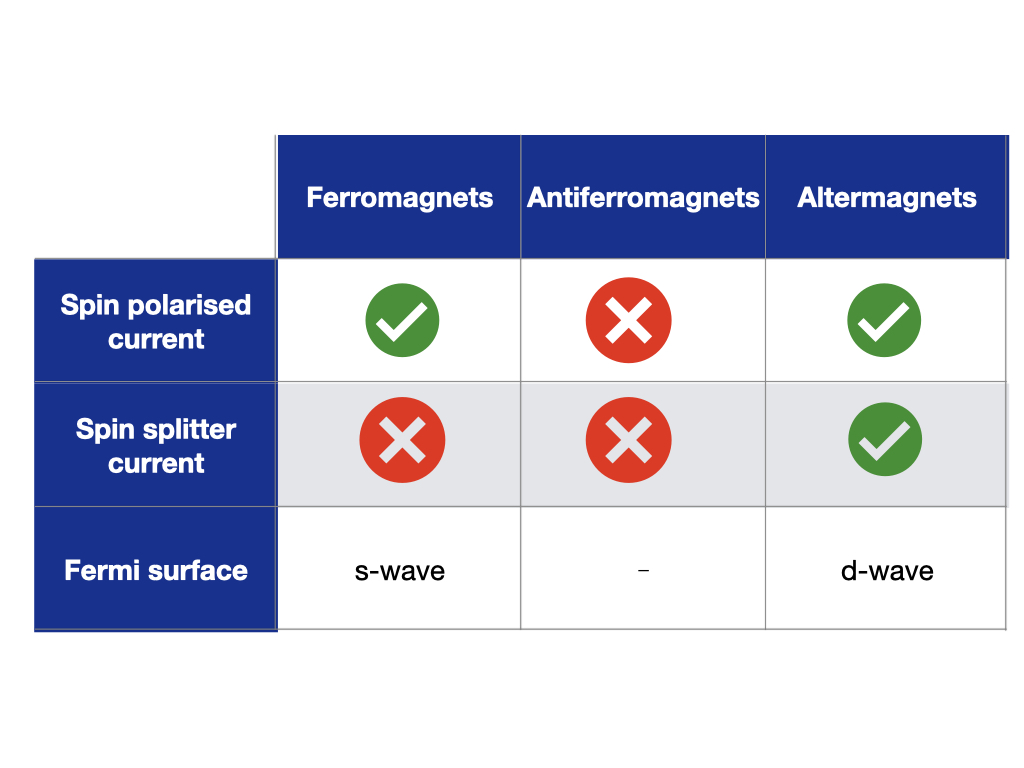
Non-relativistic spin current responses on each magnetic collinear phase. Spin splitter current is only possible in Altermagnets.
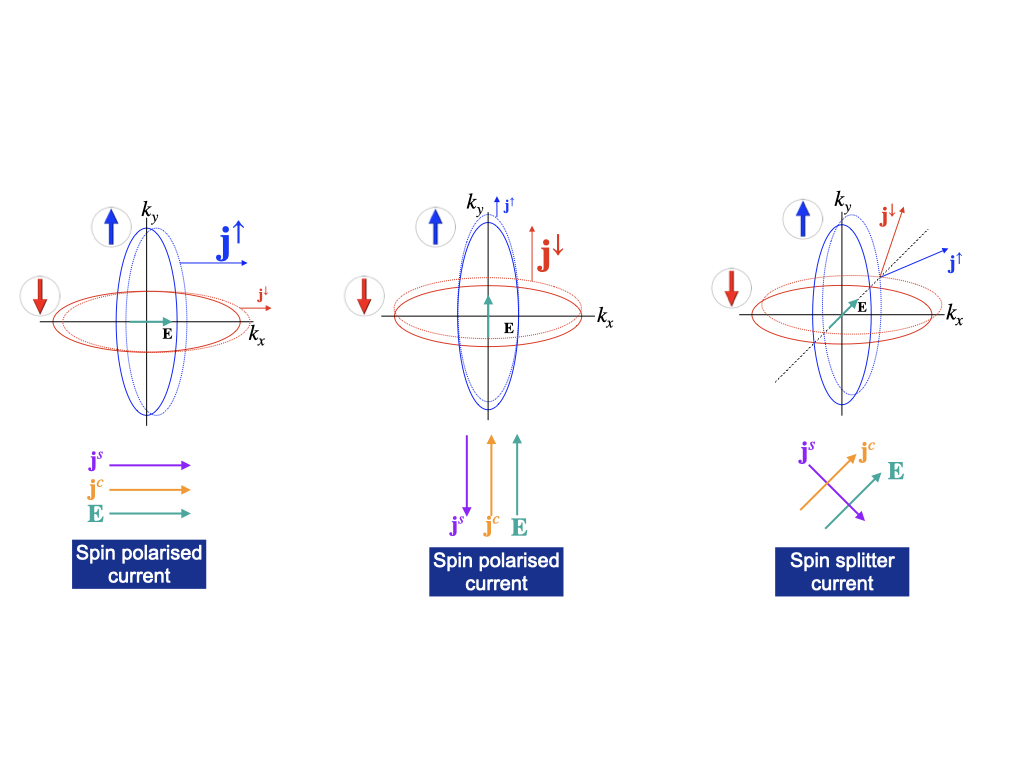
Responsse of a d-wave altermagnet under the effect of an electric field applied in different directions. (left and center) Spin polarized current with opposite spin polarization. (right) Spin splitter current.


Posted on

Anna Birk Hellenes

I am fascinated by the potential of altermagnets and odd-parity-wave magnets, as they are highly spin-active yet display no overall magnetic fields. My work involves exploring these unique materials with a vision to develop computing solutions that are denser, faster, and more energy-efficient.

Research interests

  • Altermagnetism
  • P-wave and odd-parity-wave magnets
  • Giant and tunneling magnetoresistance in altermagnets

Invited talks

  • “Altermagnets and odd-parity-wave magnets”

Quantum Physics and Technology (qGAP) Seminar, University of Oslo, June 2025

  • “Odd-parity-wave magnets”

IEEE Magnetic Frontiers 2025, Liblice, Czech Republic

  • “Unconventional p-wave magnets”

ICM 2024, Focus Session on Altermagnetism (major magnetism conference)

  • “From altermagnets to p-wave magnets: electronic structure and spintronics applications”

Spins, Waves and Interactions 2024, Greifswald (spintronics workshop)

  • “From spin symmetries to magnetoresistance effects in altermagnets”

Spintronics and Quantum transformation 2023, Jülich (EU-Japan workshop)

  • “Altermagnetic crystals and spin-polarized transport”

Nanophysics and Nanotechnology seminar organized by Prof. Roland Wiesendanger, University of Hamburg, November 2023

  • “Giant magnetoresistance effects in altermagnets”

Seminar in group of Prof. Stefano Sanvito, Trinity College Dublin, May 2023

Education

Ph.D. Computational Condensed Matter Physics, Johannes Gutenberg Univeristy | 2020-2025

  • Distinction (Summa cum laude)

M.Sc. Quantum Physics, Niels Bohr Institute, University of Copenhagen | 2017-2019

  • Honorary Graduate Award, Frederikke Lørup's Memorial Donation

B.Sc. Physics, University of Oslo | 2014-2017

  • Academic Exchange Semester, Nagoya University | 2016

Altermagnetism Q&A

What are altermagnets?

Altermagets are collinear, magnetically compensated magnets that belong to a spin symmetry class (type-III), which means that atoms with opposite spins are related by rotating and/or mirrorring them [1]. The altermagnetic type-III spin symmetry class is completely distinct from that of ferro(ferri-)magnets (type-I) and antiferromagnets (type-II). Consequently, altermagnets have alternating spin polarizations in real and wave-vector space. This combination is not available in neither ferro(ferri-)magnets nor antiferromagnets [1].

What makes altermagnets interesting?

The symmetries of altermagnets dictate that their energy-wavevector dispersions are spin-polarized and spin-split. A combination of nonrelativistic quantum mechanical exchange and crystal fields that are naturally present in the system dictates the size of this spin splitting energy. In other words, the spin splitting in altermagnets is not a relativistic correction, and its size in energy can therefore be orders of magnitude larger than splittings due to spin-orbit coupling. In turn, altermagnets are candidates for hosting many unconventional spintronics effects, such as an unconventional anomalous Hall effect [2], spin currents, and giant and tunneling magnetoresistance [3-5], and this without creating large stray fields like in ferromagnets or requiring large spin orbit-coupling. Moreover, several materials researched in other fields, such as magnetic semiconductors, insulators, and superconductors, also exhibit altermagnetic symmetries [6].

Is there experimental evidence of altermagnetism?

The first description of the altermagnetic electronic band structure in the entire Brillouin zone predicted that altermagnets host time-reversal symmetry broken energy bands and the anomalous (crystal) Hall effect [2]. This effect was measured in several altermagnetic candidates [7-9]. Also, spin currents have been indirectly measured via the torque an altermagnetic candidate exerts on a ferromagnet [10-12]. Such measurements suggests that these systems can be altermagnetic, as the effects are possible due to the specific symmetries of altermagnets. Moreover, time-reversal symmetry breaking of the electronic band structure was observed directly in a material candidate [13]. Most recently, (spin-polarized) ARPES showed the band structure lifts Kramers spin degeneracy altermagnetically [14-19], which is considered direct evidence of altermagnetism. This has created excitement also beyond the scientific community.

[1] Šmejkal, L., Sinova, J., and Jungwirth, T., Phys. Rev. X 12, 031042 (2022). arXiv:2105.05820.
[2] Šmejkal, L., González-Hernández, R., T. Jungwirth, and J. Sinova, Sci. Adv., 6, 23, 6 (2020). arXiv:1901.00445.
[3] Rafael González-Hernández, Libor Šmejkal, Karel Výborný, et al., Phys. Rev. Lett. 126, 127701 (2021).
[4] Šmejkal, L., Hellenes, A. B., González-Hernández, R., Sinova, J., and Jungwirth, T., Phys. Rev. X 12, 011028 (2022). arXiv:2103.12664.
[5] Shao, DF., Zhang, SH., Li, M. et al. Nat Commun 12, 7061 (2021). arXiv:2103.09219.
[6] Šmejkal, L., Sinova, J., and Jungwirth, T., Phys. Rev. X 12, 040501 (2022).
[7] Feng, Z., Zhou, X., et al. Nat Electron 5, 735–743 (2022). arXiv:2002.08712.
[8] Gonzalez Betancourt, R. D., et al. Phys. Rev. Lett. 130, 036702 (2023). arXiv:2112.06805.
[9] Reichlova, H., ..., Hellenes, A. B., et al. Nat Commun 15, 4961 (2024). arXiv:2012.15651.
[10] Bose, A., Schreiber, N.J., Jain, R. et al. Nat Electron 5, 267–274 (2022).
[11] H. Bai, L. Han et al., Phys. Rev. Lett. 128, 197202 (2022).
[12] Karube, S., Tanaka, T., et al., Phys. Rev. Lett. 129, 137201 (2022).
[13] O. Fedchenko, J. Minar, A. Akashdeep, ..., Hellenes, A. B., et al., Sci. Adv 10, eadj4883 (2024).
[14] J. Krempaský, L. Šmejkal, ..., Hellenes, A. B., et al., Altermagnetic lifting of Kramers spin degeneracy. Nature 626, 517–522 (2024). arXiv:2308.10681.
[15] Suyoung Lee, Sangjae Lee, et al., Phys. Rev. Lett. 132, 036702 (2024). arXiv:2308.11180.
[16] T. Osumi, [16] T. Osumi, S. Souma, et al., arXiv:2308.10117.
[17] Reimers, …, Hellenes, A. B., et al. Nat. Commun. 15, 2116 (2024), arXiv:2310.17280.
[18] Ding et al., Phys. Rev. Lett. 133, 206401 (2024), arXiv:2405.12687.
[19] Zeng et al., Adv. Sci. 11, 43, 2406529 (2024), arXiv:2405.12679.

News

Science Magazine recognized altermagnetism as one of the top 10 science breakthroughs of 2024, Dec. 12, 2024.

Science Magazine article wrote about the evolution of the altermagnetism field and the newest spectroscopy experiments on Feb. 6, 2024.

The Economist wrote about altermagnetism and spectroscopic evidence on Jan. 24, 2024.

Organized the PhD focus session at the 2024 German physics society (DPG) meeting in Berlin on the topic "Altermagnets: foundations and experimental evidence". The program is available here.

Gave talk in course "

Gave talk in focus session "Altermagnetism: Transport, Optics, Excitations" at the DPG meeting, March 2023.

Poster prize at the European school of magnetism 2022 together with Elena Stetco, who herself won a price for writing the winning nomination. The topic of the poster was altermagnetism and giant magnetoresistance effects with them.

Gave talk in course "

Selected Publications

See also: Google scholar

arXiv:2309.01607

P-wave magnets. Anna Birk Hellenes, Tomáš Jungwirth, Jairo Sinova, Libor Šmejkal.

Nature

Altermagnetic lifting of Kramers spin degeneracy. J. Krempaský, L. Šmejkal, S.W. D'Souza, M. Hajlaoui, G. Springholz, K. Uhlířová, F. Alarab, P.C. Constantinou, V. Strokov, D. Usanov, W.R. Pudelko, R. González-Hernández, A. Birk Hellenes, Z. Jansa, H. Reichlová, Z. Šobáň, R. D. Gonzalez Betancourt, P. Wadley, J. Sinova, D. Kriegner, J. Minár, J.H. Dil, T. Jungwirth. arXiv:2308.10681

Nature Communications

Direct observation of altermagnetic band splitting in CrSb thin films. Sonka Reimers, Lukas Odenbreit, Libor Smejkal, Vladimir N. Strocov, Procopios Constantinou, Anna Birk Hellenes, Rodrigo Jaeschke Ubiergo, Warlley H. Campos, Venkata K. Bharadwaj, Atasi Chakraborty, Thiboud Denneulin, Wen Shi, Rafal E. Dunin-Borkowski, Suvadip Das, Mathias Kläui, Jairo Sinova, Martin Jourdan.

Science Advances

Observation of time-reversal symmetry breaking in the band structure of altermagnetic RuO2. Olena Fedchenko, Jan Minár, Akashdeep Akashdeep, Sunil Wilfred D’Souza, Dmitry Vasilyev, Olena Tkach, Lukas Odenbreit, Quynh Nguyen, Dmytro Kutnyakhov, Nils Wind, Lukas Wenthaus, Markus Scholz, Kai Rossnagel, Moritz Hoesch, Martin Aeschlimann, Benjamin Stadtmüller, Mathias Kläui, Gerd Schönhense, Tomas Jungwirth, Anna Birk Hellenes, Gerhard Jakob, Libor Šmejkal, Jairo Sinova, Hans-Joachim Elmers (2024).

Nature Communications

Observation of a spontaneous anomalous Hall response in the Mn5Si3 d-wave altermagnet candidate. Helena Reichlova, Rafael Lopes Seeger, Rafael González-Hernández, Ismaila Kounta, Richard Schlitz, Dominik Kriegner, Philipp Ritzinger, Michaela Lammel, Miina Leiviskä, Anna Birk Hellenes, KamilOlejník, Vaclav Petřiček, Petr Dolězal, Lukas Horak, Eva Schmoranzerova, Antonín Badura, Sylvain Bertaina, Andy Thomas, Vincent Baltz, Lisa Michez, Jairo Sinova, Sebastian T. B. Goennenwein, Tomáš Jungwirth, and Libor Šmejkal (2024).

Physical Review X

Giant and Tunneling Magnetoresistance in Unconventional Collinear Antiferromagnets with Nonrelativistic Spin-Momentum Coupling. Libor Šmejkal, Anna Birk Hellenes, Rafael Gonzáles-Hernández, Jairo Sinova, Tomáš Jungwirth (2022).

Physical Review Letters

Nonlocal conductance spectroscopy of Andreev bound states: Symmetry relations and BCS charges. Jeroen Danon, Anna Birk Hellenes, Esben Bork Hanse, Lucas Casparis, Andrew P. Higginbotham, and Karsten Flensberg (2020).


Posted on