Year: 2023

20.12.2023 New Joint Publication in Altermagnetic Magnonics

A joint publication with Jairo Sinova and Libor Šmejkal about crystal magnons in altermagnets has been published in Physical Review Letters.

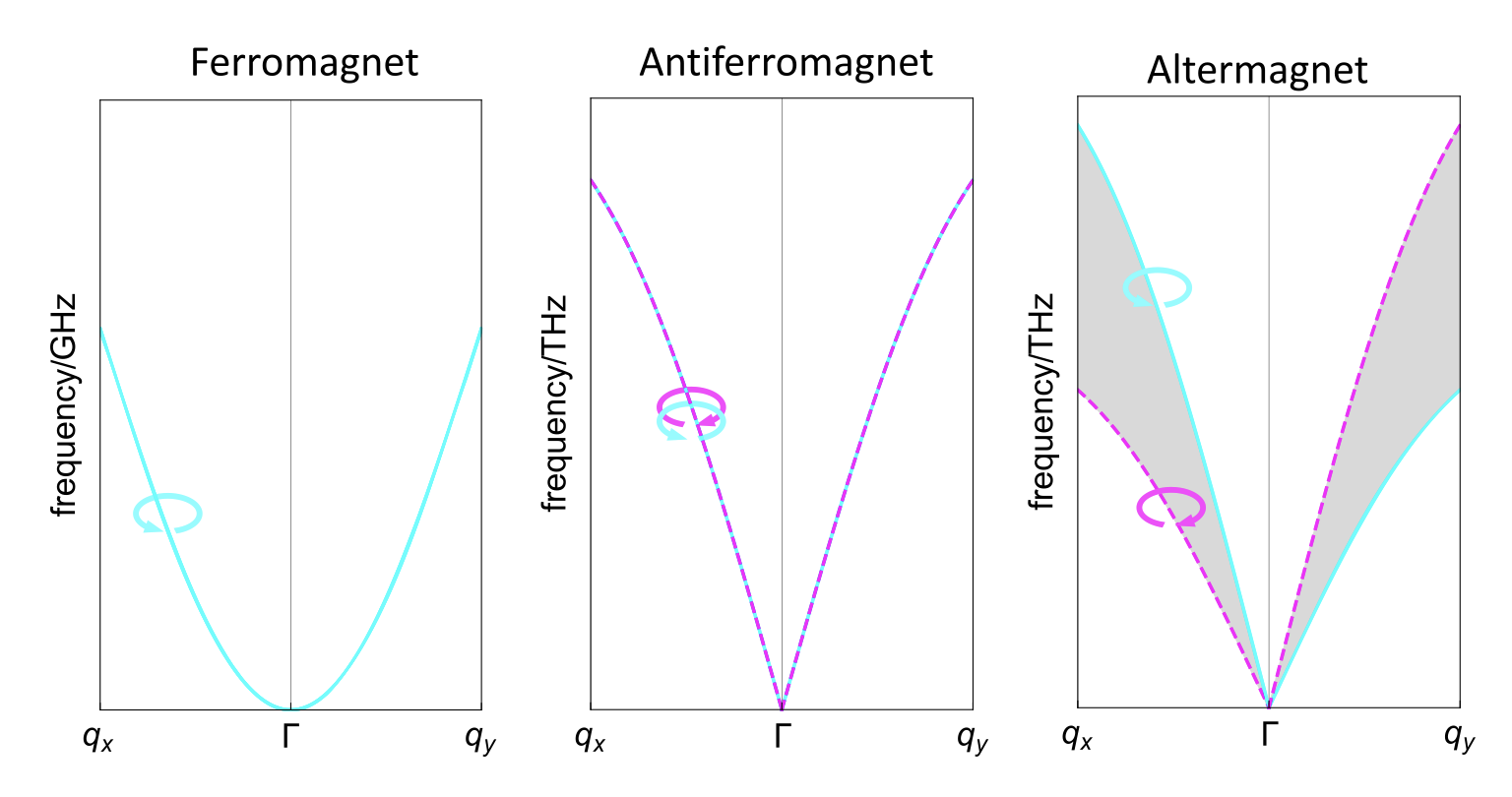
They theoretically demonstrate a new class of magnons on a prototypical d-wave altermagnet
RuO2 with the compensated antiparallel magnetic order in the ground state. Based on density-functional-theory calculations they observe that the THz-range magnon bands in RuO2 have an alternating chirality splitting, similar to the alternating spin splitting of the electronic bands, and a linear magnon dispersion near the zero wave vector. They also show that, overall, the Landau damping of this metallic altermagnet is suppressed due to the spin-split electronic structure, as compared to an artificial antiferromagnetic phase of the same RuO2 crystal with spin-degenerate electronic bands and chirality-degenerate magnon bands.

You can find the publication under Phys. Rev. Lett. 131, 256703 (2023).

08.12.2023 New Publication in Antiferromagnetic Transport Theory

A joint publication with Libor Šmejkal and Rafeal González-Hernández about the Anomalous Hall Effect in in doped AgCrSe2 has been published in Advanced Science.

They report the observation of a spontaneous AHE in doped AgCrSe2, a layered polar semiconductor with an antiferromagnetic coupling between Cr spins in adjacent layers. The anomalous Hall resistivity is comparable to the largest observed in compensated magnetic systems to date, and is rapidly switched off when the angle of an applied magnetic field is rotated to ≈80° from the crystalline c-axis. The ionic gating experiments show that the anomalous Hall conductivity magnitude can be enhanced by modulating the p-type carrier density. They also present theoretical results that suggest the AHE is driven by Berry curvature due to noncollinear antiferromagnetic correlations among Cr spins, which are consistent with the previously suggested magnetic ordering in AgCrSe2. Their results open the possibility to study the interplay of magnetic and ferroelectric-like responses in this fascinating class of materials.

You can find the publication under Adv. Sci. 2023, 2307306 (2023).

04.12.2023 New Joint Publication in Topological Altermagnetism

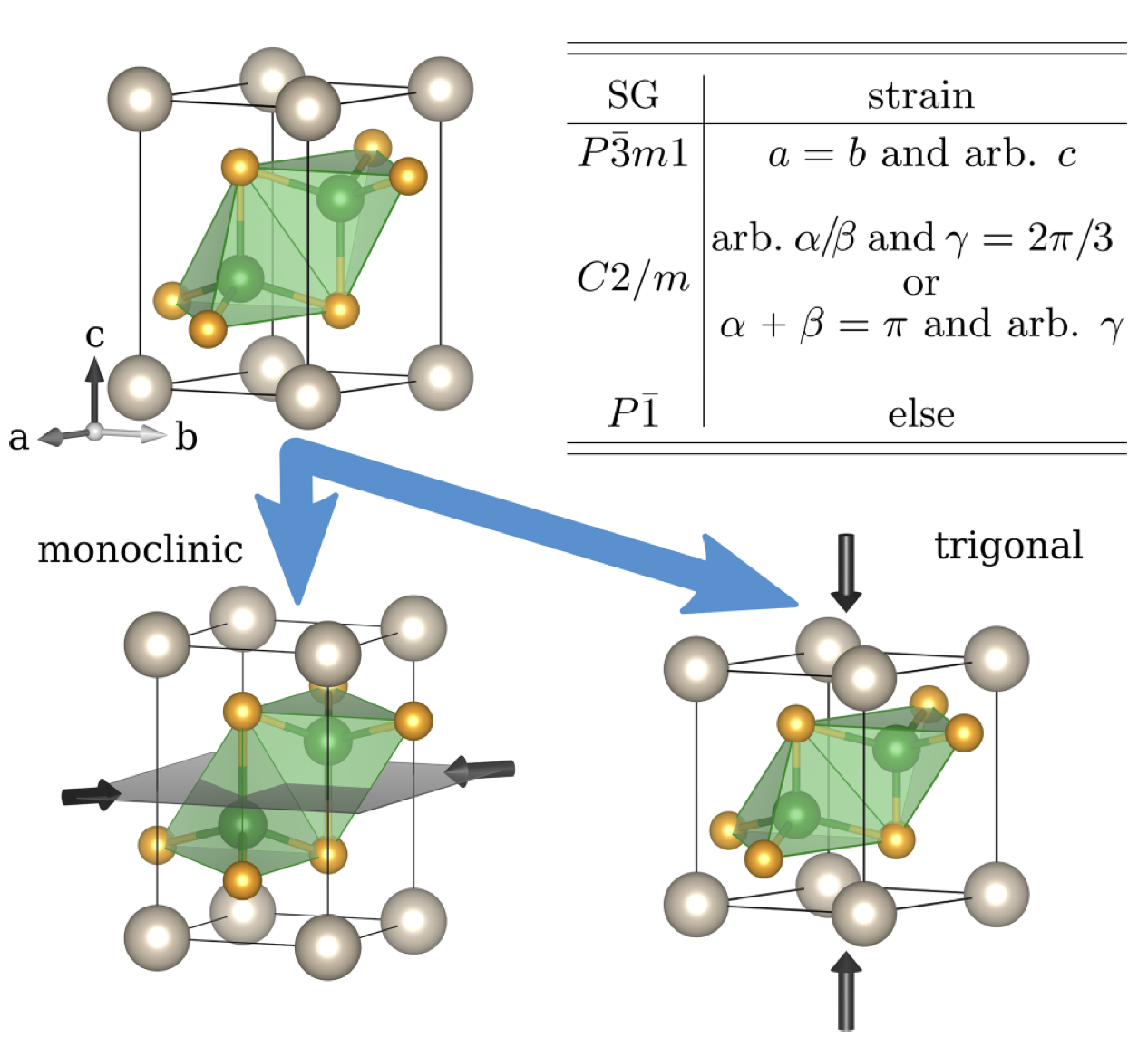
A joint publication with Jairo Sinova and Libor Šmejkal about the influence of magnetism, strain, and pressure on the band topology of EuCd2As2 has been published in Physical Review B.

They analyze the role of the delicate interplay of Eu magnetism, strain, and pressure on the realization of nontrivial topological phases. For that they invoke a combination of a group theoretical analysis with ab initio density functional theory calculations and uncover a rich phase diagram with various nontrivial topological phases beyond a Weyl semimetallic state, such as axion and topological crystalline insulating phases, and discuss their realization.

You can find the publication under Phys. Rev. B 108, 235113 (2023).

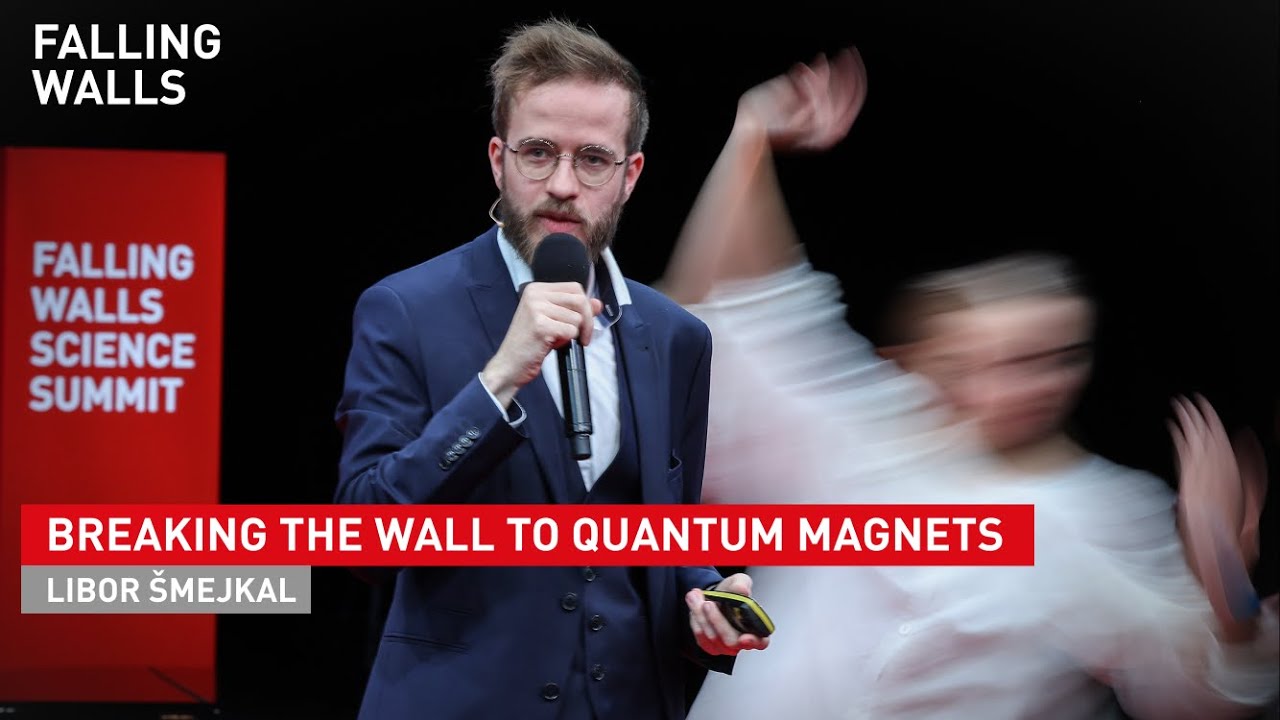
09.11.2023 Libor Šmejkal wins the "Falling Walls Science Breakthrough of the Year 2023" award in physical sciences

Congratulations to Libor Šmejkal for winning the Falling Walls Science Breakthrough of the Year 2023 award in physical sciences.

In the Falling Walls science summit the brightest minds in science, politics, business and the media come together to present groundbreaking discoveries and scientific breakthroughs and emerging trends that shape our world. Libor was awarded for his his breakthrough of altermagnets—a discovery that has the potential to revolutionise the way we design and use electronic technology, making it much more efficient and sustainable.

03.10.2023 New Joint Publication in Frustrated Magnetism

A joint publication with Jairo Sinova and Ricardo Zarzuela about spin-transfer and topological Hall effects in itinerant frustrated magnets has been published in Physical Review B.

They examine the spin-transfer and topological Hall physics of metallic frustrated magnets and show that SO(3) solitons and magnetic disclinations mediate previously unidentified contributions to the corresponding effects, with no analog in collinear magnetism. In particular, they present a minimal low-energy long-wavelength theory of the Yang-Mills type for the itinerant carriers and also discuss the emergent electrodynamics mediated by the topological solitons/defects arising in the noncoplanar magnetic background. They also considered the effect of symmetry reduction (with respect to the case of full rotational symmetry) on both spin-transfer and topological Hall responses of the magnetic conductor. Furthermore, they discuss experimental setups for the detection of the aforesaid Hall currents. Their findings open new avenues for the detection of topological solitons/defects in magnetic systems with order-parameter manifolds beyond the conventional S2 paradigm.

You can find the publication under Phys. Rev. B 108, 134402 (2023).

02.10.2023 New Joint Publication in Altermagnetism

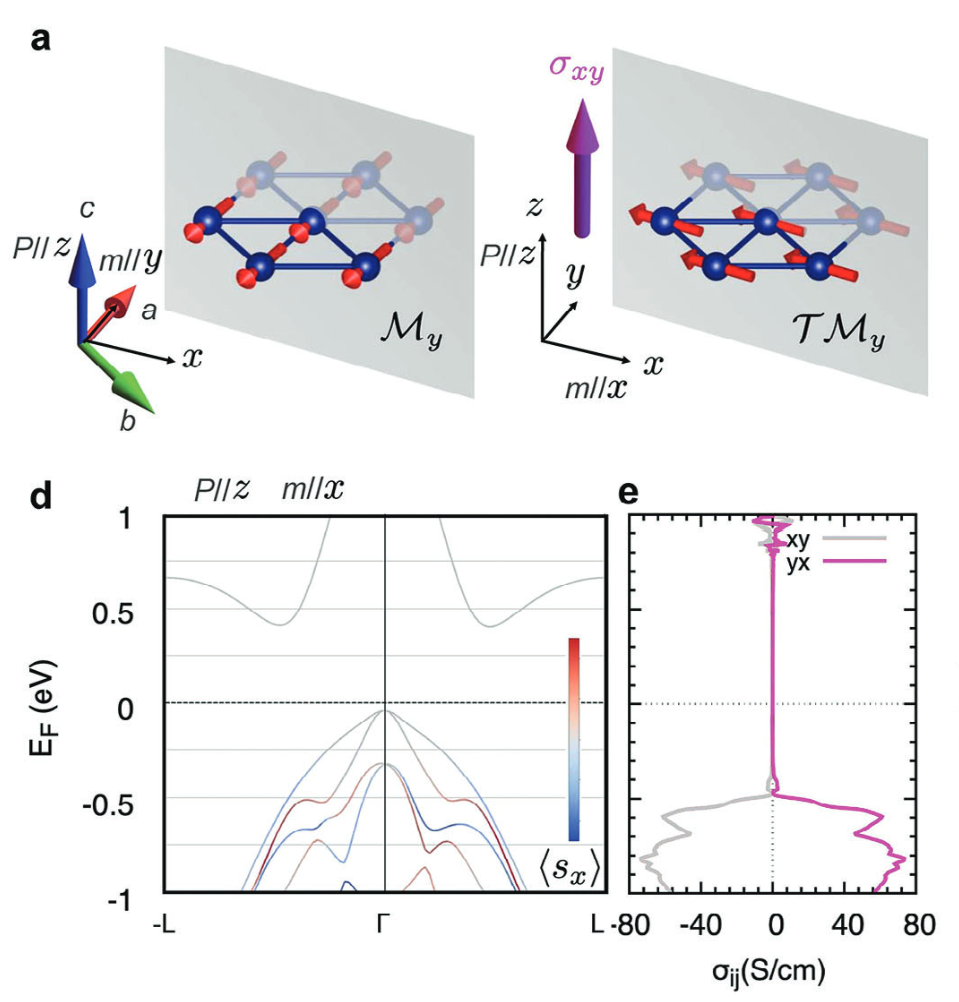
A joint publication with Jairo Sinova and Libor Šmejkal about the saturation of the anomalous Hall effect at high magnetic fields in altermagnetic RuO2 has been published in APL Materials.

They used a field-induced reorientation of the Néel vector from the easy-axis toward the [110] hard-axis to demonstrate the anomalous Hall signal in this RuO2. They confirm the existence of an anomalous Hall effect in our RuO2 thin-film samples, whose set of magnetic and magneto-transport characteristics is consistent with the earlier report. By performing their measurements at extreme magnetic fields up to 68 T, they reach saturation of the anomalous Hall signal at a field Hc ≃ 55 T that was inaccessible in earlier studies but is consistent with the expected Néel-vector reorientation field.

You can find the publication under APL Mater. 11, 101103 (2023).

27.09.2023 New Publication in Antiferromagnetic Spintronics

A publication with Helen Gomonay about nonlinear magnon dynamics in Mn2Au has been published in Nature Communications.

They excite Mn2Au thin films with phase-locked single-cycle terahertz electromagnetic pulses and monitor the spin response with femtosecond magneto-optic probes. They observe signals whose symmetry, dynamics, terahertz-field scaling and dependence on sample structure are fully consistent with a uniform in-plane antiferromagnetic magnon driven by field-like terahertz NSOTs with a torkance of (150 ± 50) cm2 A−1 s−1. Their research indicates that fully coherent Néel-vector switching by 90° within 1 ps is within close reach.

You can find the publication under Nat Commun 14, 6038 (2023).

24.07.2023 New Joint Publication in Antiferromagnetic Spintronics

A joint publication with Tobias Wagner and Helen Gomonay about coupling of ferromagnetic and antiferromagnetic spin dynamics in Mn2Au/NiFe thin film bilayers has been published in Physical Review Letters.

They investigate magnetization dynamics of Mn2Au/Py (Ni80Fe20) thin film bilayers using broadband ferromagnetic resonance (FMR) and Brillouin light scattering spectroscopy. Their model reveals the dependence of the hybrid modes on the AFMR frequencies and interfacial coupling as well as the evanescent character of the spin waves that extend across the Mn2Au/Py interface.

You can find the publication under Phys.Rev.Lett.131,046701.

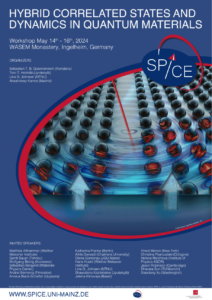
23.07.2023 Upcoming SPICE Workshop on Hybrid Correlated States and Dynamics in Quantum Materials

The SPICE workshop "Hybrid Correlated States and Dynamics in Quantum Materials" will be held from May 14th to 16th, 2024 at the historic WASEM winery, Ingelheim.

The workshop focusses on correlated states of electrons, that give rise to quantum matter, such as ordered magnets, spin liquids, superconductors, and topological materials. The exciting phenomena hosted and technological applications promised by these states of matter have further inspired the scientific community to engineer hybrids where different ingredients for correlations are provided by separate materials coupled together. Thus, such low-dimensional hybrid nanostructures have enabled engineering novel states of matter with intriguing physics, often not admitted by any single platform.

With the recent developments, theoretical and experimental, time reversal symmetry breaking via magnetism has emerged as a powerful tool to engineer novel unconventional superconducting states and phenomena such as nonreciprocity. At the same time, engineering of the superconducting condensate to bear a net spin employing magnet/superconductor hybrids has been demonstrated. This has opened prospects for superconducting spintronics devices enabling dissipationless spin torques and logic. Further, spin fluctuations appear to play a fundamental role in a large fraction of unconventional and two-dimensional superconductors including the recently discovered states in moiré materials. Therefore, these three seemingly disjoint fields are intricately relying on knowledge from each other and can best be tackled with an overview of all three. Providing this overview and a common discussion platform is the main goal of this workshop.

The workshop shall bring together experts and young researchers from three different communities: (i) Magnetism and Spintronics, (ii) Superconductivity and Strongly Correlated Electrons, and (iii) Low-dimensional nanostructures. The purview includes coherent and incoherent magnetization dynamics in conjunction with the various spintronics effects that allow its manipulation and detection. A key topic will be the recently discovered nonreciprocal effects in magnets e.g., chiral magnons, as well as superconductors, e.g., the superconducting diode effect. Recent discoveries regarding two-dimensional materials, multi-orbital superconductivity, Ising superconductors, topological superconductivity and quantum sensors coupled to magnets will also be central to the workshop portfolio. Employing fluctuations of currents (e.g, flow of spin or vortices) to probe the quantum nature of transport will form an exciting topic of discussion across communities. Finally, the case of spin fluctuations mediated superconductivity, that is believed to underlie a wide range of unconventional superconductors can best be discussed with the three communities present at the workshop.