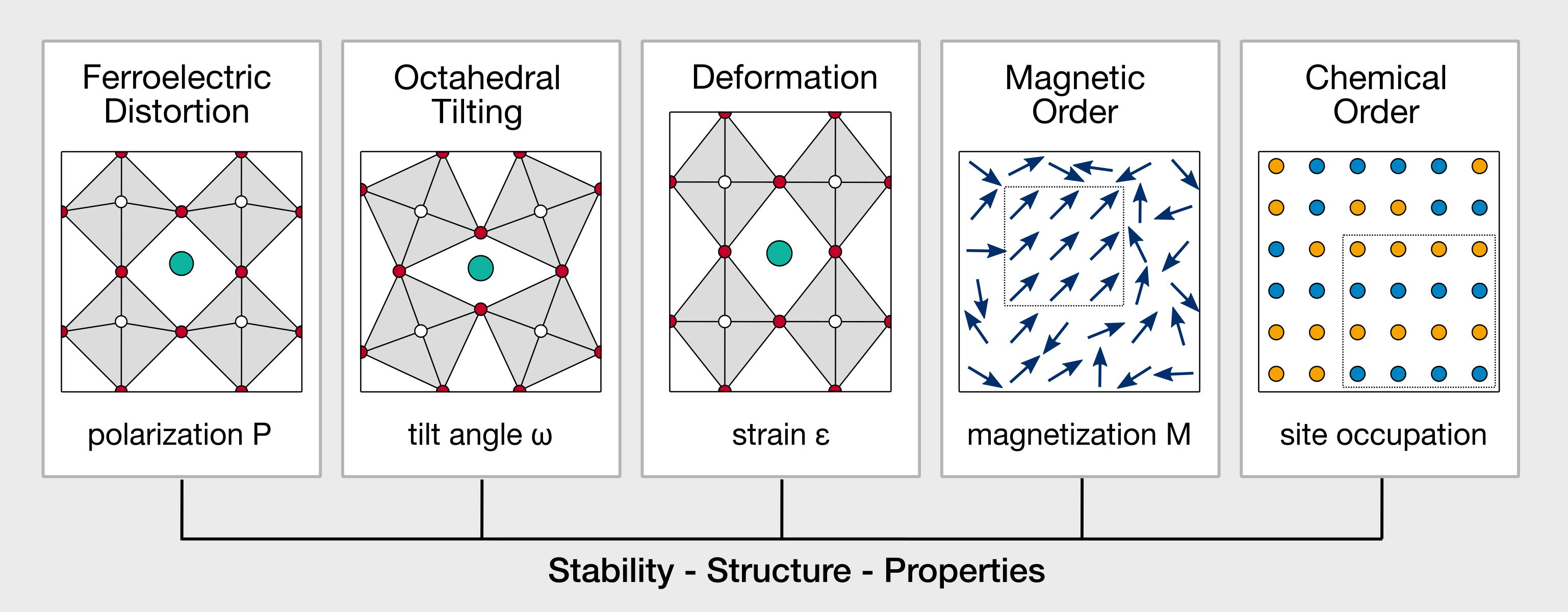
The Computational Material Design group is combining the properties of materials to enhance or create new physical phenomena. The versatility of multiferroics, that combine ferroelectricity, magnetism and deformation, is an ideal playground. In this family of material, those combining ferroelectricity and magnetism, so-called magneto-electrics, are of particular interest for technological application.
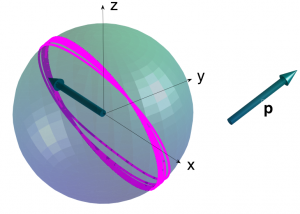
Our strength is based on the ability to study both the equilibrium and out-of-equilibrium properties of multiferroics. We focus on the non-collinear states of matter, such as magnetic skyrmions and spin spirals or magneto-electric domain walls, in which both equilibrium and non-equilibrium properties are intimately connected.
Methods
Our approach is based on density functional theory (DFT) to understand the fundamental properties of materials such as ferroelectric polarization, magnetic couplings, transport properties and their interplay. Due to its high computational cost, DFT is limited to the study of several tens of atoms at 0 Kelvin. In order to reach the experimental temperatures and length scales, we map our DFT results onto Hamiltonians which are then solved via Monte-Carlo or spin dynamics simulations.
Therefore, the Computational Materials Design subgroup is composed of experts from several fields who can cover a broad range of materials, length and temperature scales. We use several DFT packages such as the FLEUR (FLAPW basis) and VASP (PAW basis) ab initio packages.
Collaborations
We benefit from the expertise of colleagues via close collaborations:
My work sits at the nexus of two major trends of contemporary materials- and nano-science:
The first is the exploitation of the lower cost, greater abundance, greater tailorability and versatility of components based on organic molecules over traditional solid state materials in microtechnology.
The second is the use of the laws of quantum mechanics and powerful computers to predict highly accurate, atomically resolved properties of nano-systems. Such computational modeling from first-principles theory is exponentially developing into an essential, extremely cost-efficient tool for academic and industrial nanotechnological research alike.
Previously, I have modeled solid surfaces functionalized with single-molecule electrooptical motors, and worked on chemically tuning the electronic motion in novel solar cells based on organic molecules and quantum-dots. My methodological experience covers electronic structure theory in various forms from the solid state to quantum chemical methods.
Currently, I lead the Organic Spintronics Team. We work on developing molecular materials and components for spintronics from atomistic theoretical models, using the full gamut of modern first-principles and multi-scale modeling methods.
Publications (Highlights)
"Polaron spin dynamics in high-mobility polymeric semiconductors", Nature Physics (2019)
"Long spin diffusion lengths in doped conjugated polymers due to enhanced exchange coupling", Nature Electronics 2, 98 (2019)
In magnetic metals, the interplay between conduction electrons subject to spin-orbit coupling and localized magnetic moments drive key magnetic effects such as spin-orbit torques. Such spin-orbit induced phenomena are believed to be vital for next generation magnetic memory devices.
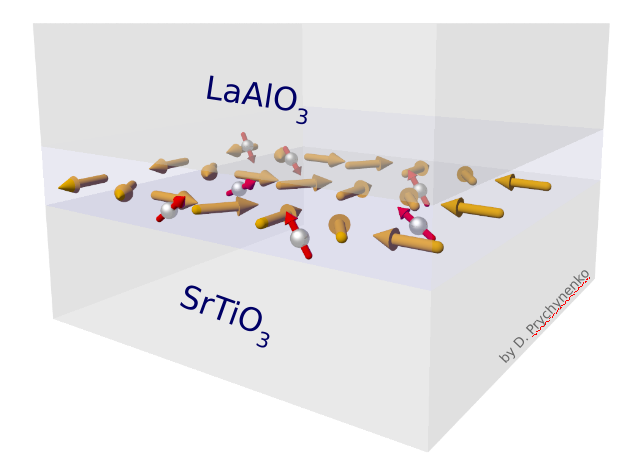
LAO/STO interface
We analyse their microscopic origin and develop models that connect with experiments. In particular, we focus on both disorder and the enhanced Rashba spin-orbit coupling at interfaces.
One prominent physical system of interest is the interface between perovskite-type oxides, where recent experiments reveal the important role of spin-orbit-induced effects with respect to the observed magnetic phases. We study the magnetic phases resulting from the interplay between spin-orbit coupling and magnetic exchange interactions via their transport properties. To capture the real-time evolution of these systems in non-equilibrium, we derive diffusion equations directly from quantum kinetic theory.
Phases of matter are classified according to order parameters and corresponding symmetries. For instance, water exhibits rotational symmetry, while ice breaks it. We have recently classified magnets by spin symmetries. We have found out that, remarkably, there exists yet third magnetic ordering in addition to the more common antiferromagnetic and ferromagnetic orderings. The unconventional altermagnetic ordering is characterised by an unconventional time-reversal symmetry breaking in the form of alternating spin order in reciprocal space which originates from anisotropic and mutually rotated opposite spin densities in direct space. Altermagnets are predicted a plethora of effects both of fundamental and applied interest such as dissipationless and spin-polarised currents, some of which were already indicated in experiments.
Our team is currently investigating altermagnetism and topological antiferromagnetic spintronics with our collaborators from Prague, Mainz, Washington, Barranquilla, Kaiserslautern, Frankfurt, Karlsruhe, Dresden, Grenoble, Nottingham, Vienna, and Pilsen.
“Beyond Conventional Ferromagnetism and Antiferromagnetism: A Phase with Nonrelativistic Spin and Crystal Rotation Symmetry”. L. Šmejkal, J.Sinova, and T. Jungwirth
“Crystal time-reversal symmetry breaking and spontaneous Hall effect in collinear antiferromagnets.”. L. Šmejkal, González-Hernández, R., T. Jungwirth, and J. Sinova
"Proposal to Detect Dark Matter using Axionic Topological Antiferromagnets". David J. E. Marsh, Kin Chung Fong, Erik W. Lentz, Libor Šmejkal, and Mazhar N. Ali
Further interests - solid state theory of relativistic effects:
Prediction and observation of large anisotropic magnetoresistance in Mn2Au alloys. Press release .
Prediction and observation of anisotropic magnetoresistance and spin-orbit torque (SOT) in Heusler alloys. SOT was demonstrated at room temperature in NiMnSb microbars: Press release .
Antiferromagnets are prospective materials for spintronic applications as they show fast magnetic dynamics, low susceptibility to the magnetic fields and produce no stray fields. They have nontrivial magnetic structure, more magnetic degrees of freedoms and peculiar dynamics, as compared to ferromagnetic materials.
Application of antiferromagnets for information storage and development implies manipulation of states with the use of the magnetic fields or electrical currents. For this one needs to study the mechanisms that govern behaviour of antiferrantiferromagentic nanoparticles and textures in the presence of the external fields. My current reseach is focused on the problems of nonequilibrium magnetic dynamics of antiferromagnets induced by spin-orbit torques, temperature gradients, mechanical stresses etc. Strong magnetoelastic coupling, which is a peculiar feature of many antiferromagnetic materials, makes these problems more complicated and more facinating.
As a teacher I have a great experience in the field of quantum information theory and hope to find a way to use antiferromagnets as the active elements of quantum bits.
At the meeting of the DFG senate, the new collaborative research centre (Sonderforschungsbereich - SFB) on spin phenomena (Spin+X) was approved. The Sinova Group takes part in this large scale project which unites the 30 leading groups in spintronics and spin - related research from Physics, Chemistry and Engineering at Johannes Gutenberg University Mainz and the TU Kaiserslautern. The project is initially funded with 12 Mio. Euros for 4 years and can be extended up to 12 years.
Johannes Gutenberg University Mainz established the Gutenberg Research College in 2007 to highlight the university's academic strengths and to promote promising new research fields. Its main instrument is the granting of fellowships to excellent researchers from all disciplines. This year, the GRC welcomed four new fellows, with Jairo Sinova among them.

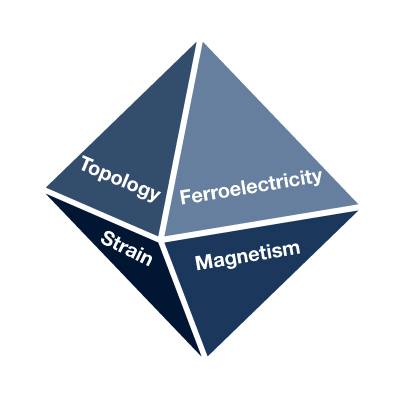 The Computational Material Design group is combining the properties of materials to enhance or create new physical phenomena. The versatility of multiferroics, that combine ferroelectricity, magnetism and deformation, is an ideal playground. In this family of material, those combining ferroelectricity and magnetism, so-called magneto-electrics, are of particular interest for technological application.