Research

30.03.2022 Joint Publication about antiferromagnetic spintronics

A joint publication from the team in antiferromagnetic spintronics about anomalous Hall antiferromagnets has been published in Nature Reviews Materials.

They review and order the recent progress about the anoumalous Hall effect in antiferromagnets. They discuss the materials with the anomalous Hall effect form both a fundamental and applied view.

You can find the publication under nature.com/articles/s41578-022-00430-3.

25.03.2022 Joint publication about antiferromagnetic spintronics

A joint publication with Helen Gomonay about  ultrafast manipuation of antiferromagnets  has been published in Communications Physics.

They show a theoretical mechanism to imprint spin chirality into collinear antiferromagnets with the use of laser pulses. These pulses then can lead to quasi-stable ciral states. The results provide a more detailed  insight on the interactions between light and chiral magnetism.

You can find the publication under nature.com/articles/s42005-022-00840-3.

10.02.2022 Publication about Unconventional Antiferromagnets


A publication from the team of antiferromagnetic spintronics about giant and tunneling magnetoresistance in unconventional collinear antiferromagnets has been published in Physical Review X.

They presentc archetype model mechanisms for the giant and tunneling magnetoresistance effects in multilayers of such materials. These mechanisms are linked to real materials through ab-initio calculations. Further they show how their models can allow for magnetic excitations by teh spin transfer torque.

You can find the publication under PhysRevB.12.011028.

07.02.2022 Joint publication about antiferromagnetic spintronics

A joint publication from the team of antiferromagnetic spintronics about domain walls driven by elastic defects has been published in Nature Communications.

They show that the domain structure in thin films of the antiferromagnet CuMnAs is dominated by elastic defects. These defects determine the location and orientation of 90° and 180° domain walls.The results show the impact of defects on the antiferromagnetic domain structure and provides a route to optimize the performance of devices.

You can find the publication under nature.com/articles/s41467-022-28311-x.

01.02.2022 Joint Publication in antiferromagnetic spintronics

A joint publication of the Kläui - Lab together with Olena Gomonay and Jairo Sinova about magnon transport in weak antiferromagnets has been published in the Journal of Magnetism and Magnetic Materials. 

In more detail, they studied the antiferromagnet hematite with the Dzyaloshinskii-Moriya interaction (DMI). The results show that the DMI gives a new reconfigurability in the long distance magnon transport within thin films. This introduces a hysteresis in the system as a consequense of a competiotion of the Zeeman field and the effective field of the DMI.

You can find the publication under j.jmmm.2021.168631.

28.01.2022 Publication by Ricardo Zarzuela and Jairo Sinova

A publication by Ricardo Zarzuela and Jairo Sinova about the spin-charge transport theory and spin-transfer physics in frustrated magnets has been published in Physical Review B.

They present a new theory based on the doped Hubbard model and the slave-boson formalism. The results of their work point towards possible new Hall physics thhat was previously unanticipated  in the studied frustrated materials.

You can find the publication under PhysRevB.105.024423.

Venkata Krishna Bharadwaj

Data has become the new oil today, with their increasing demands for faster, denser, non-volatile, and low-power-consuming technologies. In this context, spintronics, which employs both charge and spin degrees of freedom, has provided some novel concepts to further state of art in this regard. Magnetic skyrmion being the new protagonist in the arena, has attracted a lot of research interest over the last decade, owing to their topological robustness and very low currents to manipulate them.

My research focuses on magnetic skyrmioms in in-plane ferromagnets and synthetic antiferromagnetic (SAF). Recently, we have studied the stability of in-plane skyrmions in collinear ferromagnets and in-plane SAFs. We have also looked at current-driven dynamics and external field-induced excitations of these in-plane skyrmions. We use both analytical and micromagnetic simulations in our research.


Publications


Arxiv

'Strain control of band topology and surface states in antiferromagnetic EuCd2As2'.Nayra A Álvarez Pari, VK Bharadwaj, R Jaeschke-Ubiergo, A Valadkhani, Roser Valentí, L Šmejkal, Jairo Sinova (2023)

Arxiv

'Direct observation of altermagnetic band splitting in CrSb thin films'. Sonka Reimers, Lukas Odenbreit, Libor Smejkal, Vladimir N Strocov, Procopios Constantinou, Anna Birk Hellenes, Rodrigo Jaeschke Ubiergo, Warlley H Campos, Venkata Krishna Bharadwaj, Atasi Chakraborty, Thiboud Denneulin, Wen Shi, Rafal E Dunin-Borkowski, Suvadip Das, Mathias Kläui, Jairo Sinova, Martin Jourdan (2023)

Arxiv

'Supercell Altermagnets'. R. Jaeschke-Ubiergo, V.K. Bharadwaj, L. Šmejkal, Jairo Sinova (2023)

Arxiv

'Homochiral antiferromagnetic merons, antimerons and bimerons realized in synthetic antiferromagnets'. Mona Bhukta, Takaaki Dohi, Venkata Krishna Bharadwaj, Ricardo Zarzuela, Maria-Andromachi Syskaki, Michael Foerster, Miguel Angel Niño, Jairo Sinova, Robert Frömter, Mathias Kläui . (2023)

Physical Review B

'Stability and dynamics of in-plane skyrmions in collinear ferromagnets'. Ricardo Zarzuela, Venkata Krishna Bharadwaj, Kyoung-Whan Kim, Jairo Sinova, and Karin Everschor-Sitte. (2020)

 

Posted on

12.01.2022 Joint publication with Jairo Sinova

A joint publication of the London Centre for Nanotechnology and the Catalan Institute of Nanoscience and Nanotechnology together with Jairo Sinova about Van der Waals layered systems has been published in Nature Reviews Physics.

They present fundamentals on van der Waals magnetism and spin–orbit coupling effects in 2D systems. It is discussed how the coexistance of both effects could establish new ways to engineer robust spin textures. The results will help in designing future non-volatile memory devices that utilize the unique properties of 2D materials.

You can find the publication under nature.com/articles/s42254-021-00403-5.

Nayra Alvarez

My current research focuses on understanding the electronic structure and band-topology of compensated magnets using a combination of density functional theory and symmetry analysis. I am particularly interested in spin transport phenomena originating from compensated magnetic orderings.

Publications:

Physical Review Letters:

  • Pari, Nayra A. Álvarez, Daniel Julio Garcia, and Pablo S. Cornaglia. "Quasiparticle mass enhancement as a measure of entanglement in the Kondo problem." Physical Review Letters125.21 (2020): 217601

Research interests:

  • Strongly correlated electron systems, quantum entanglement.
  • Topological phases of matter, such as Dirac semimetals, Topological insulators.
  • First principle calculations, DFT, and post-processing.
Posted on

Dr. Tobias M. Wagner

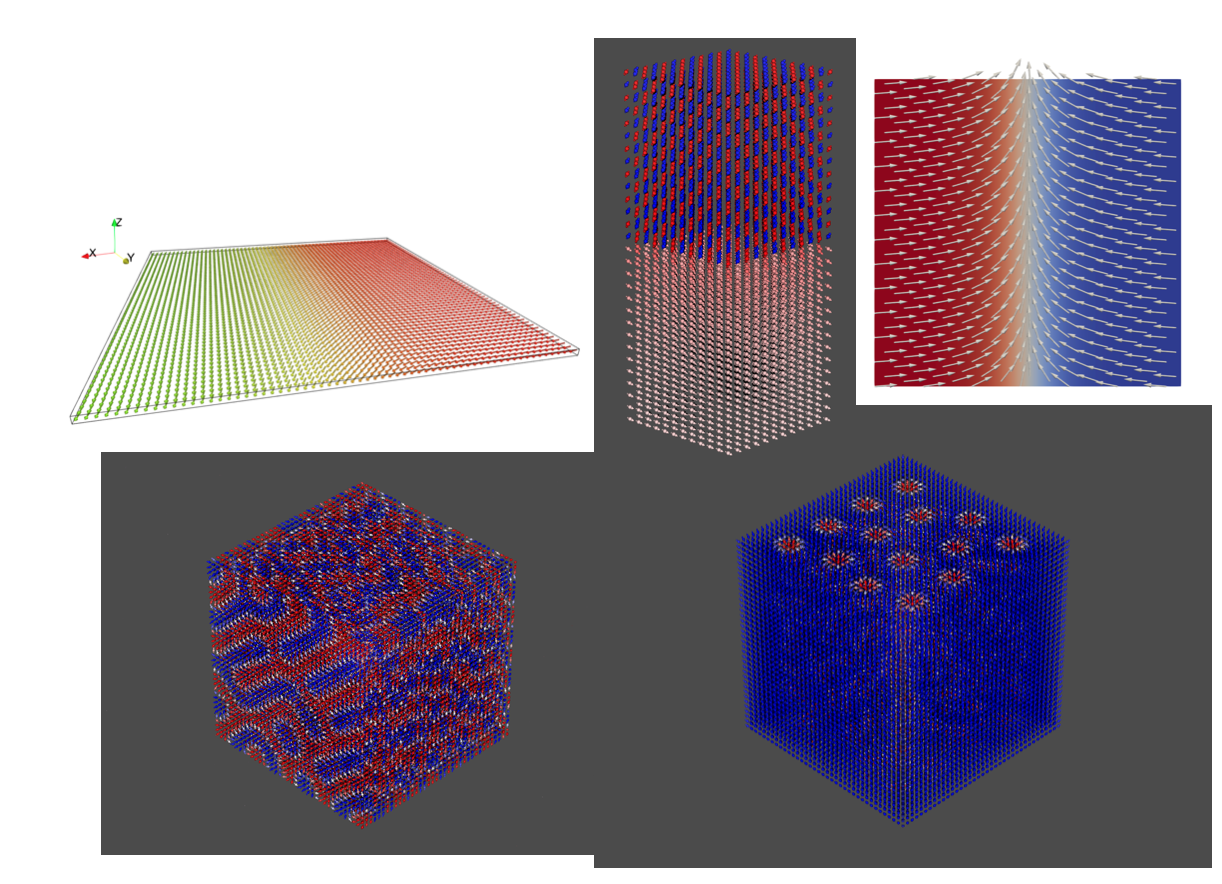
Antiferromagnets (AFMs) possess characteristics that make them ideal for spintronic applications: intrinsically, AFM dynamics are much faster compared to FM, AFMs are insensitive to external fields due to their zero net magnetization and produce no stray fields. However, FMs can be manipulated more efficiently. Thus combining AFMs and FMs into hybrid devices to exploit the manipulability of FMs together with the speed of AFMs is a desirable goal. Today, such hybrid devices are widely used, with AFMs having a passive role.

My research is directed to investigate whether AFMs can also be used as active parts in hybrid devices. I am interested in both the static domain wall configurations and domain wall dynamics originating from the combination of an AFM with a FM layer. While using analytical methods to understand the physics and link phenomenology to microscopic theories, I utilize atomistic simulations from ab initio constants and micromagnetic simulations to model larger and more realistic systems that can be compared to experimental data. In a collaboration with the group of Prof. Dr. Nowak at the University of Konstanz I co-develop atomistic spin dynamics simulations. I enjoy working in an interdisciplinary environment in close collaboration with colleagues from both theoretical and experimental physics. On a broader scale I am also interested in scientific applications of machine learning and artificial intelligence.

Research Interests:

  • Condensed Matter Physics
  • Interdisciplinary research in experimental and theoretical study of magnetism Antiferromagnetic Spintronics
  • Antiferromagnetic-ferromagnetic Hybrid Systems
  • Atomistic and Micromagnetic Simulations
  • Machine Learning

Publications and Preprints:

From Magnetostatics to Topology: Antiferromagnetic Vortex States in NiO-Fe Nanostructures
M. Ślęzak, T. Wagner, V. K. Bharadwaj, O. Gomonay, A. Kozioł-Rachwał, T. O. Menteş, A. Locatelli, M. Zając, D. Wilgocka-Ślęzak, P. Dróżdż, T. Ślęzak,
Adv. Mater. Interfaces 2024, 2400309

Revealing the ultra-fast domain wall motion in Mn2Au through permalloy capping,
Sarah Jenkins, Tobias Wagner, Olena Gomonay, Karin Everschor-Sitte,
Phys. Rev. B 109, 224431 – Published 27 June 2024

Coupling of ferromagnetic and antiferromagnetic spin dynamics in Mn2Au/NiFe thin-film bilayers, Hassan Al-Hamdo, Tobias Wagner, Yaryna Lytvynenko, Gutenberg Kendzo, Sonka Reimers, Moritz Ruhwedel, Misbah Yaqoob, Vitaliy I. Vasyuchka, Philipp Pirro, Jairo Sinova, Mathias Kläui, Martin Jourdan, Olena Gomonay, Mathias Weiler,
Phys. Rev. Lett. 131, 046701 – Published 24 July 2023

Néel-vector Control of Magnetization Dynamics in α-Fe2O3/NiFe Heterostructures
Hassan Al-Hamdo, Tobias Wagner, Philipp Schwenke, Gutenberg Kendzo, Maximilian Dausend, Laura Scheuer, Misbah Yaqoob, Vitaliy I. Vasyuchka, Philipp Pirro, Olena Gomonay, Mathias Weiler
Phys. Rev. B 111, L180401 (2025)


Posted on