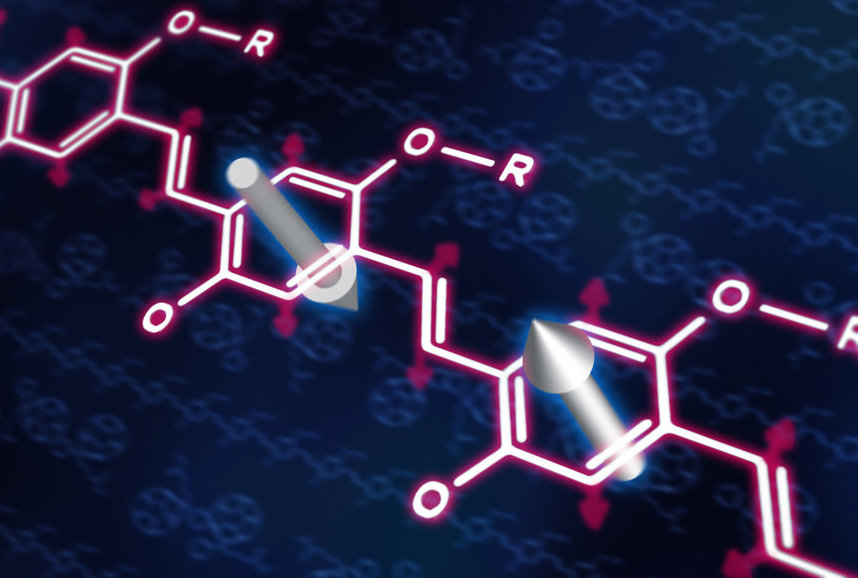
A joint publication by the Organic Spintronics Team showing how key spintronic properties of organic molecules adsorbed at a solid surface may be precisely tuned by modifying the adsorbate structure has been published in Physical Review Letters.
Left: Illustration of spin injection from an inorganic solid substrate into an organic adsorbate layer. Center: Sketch of the adsorption geometry. Right: The adsorbates studied.
More precisely, experiments performed by our collaborators at Cambridge University (UK), show a broadening of the electron spin resonance (ESR) linewidth upon spin injection from a permalloy surface into thin films of DNTT-based organic molecules. This broadening depends sensitively on the composition and surface bonding of the adsorbate molecules.
With the support of theoretical calculations performed by collaborators at Mons University (BE), significant differences in, e.g., the spin diffusion lengths of the organic adsorbate layers can be inferred from the measured variations in ESR linewidth.
A publication by the Organic Spintronics Team (OST) revising the established method for calculation of molecular spin admixture parameters from first-principles electronic structure theory has been published in Physical Review B. Spin states in a semi-conductor or molecule are a mixture of up and down, because of spin-orbit coupling (SOC). Spin admixture is one of the main ways in which SOC influences the spin dynamics in a molecular material.
The revised method for calculating spin admixture improves on a number of approximations made in the previous method, resulting in greater accuracy and transferability. Still, this method relies on efficient, standard electronic structure theory only, making it easy to implement, and suitable for large-scale calculations.
Molecules in which the new spin admixture method has been evaluated. a) Benzene and thiophene, b) biphenyl, and c) M-phthalocyanines, for M = VO, Mn, Co, Cu.
A publication by the Organic Spintronics Team (OST) revising the established method for calculation of molecular spin admixture parameters from first-principles electronic structure theory has been accepted for publication in Physical Review B. Spin states in a semi-conductor or molecule are a mixture of up and down, because of spin-orbit coupling (SOC). Spin admixture is one of the main ways in which SOC influences the spin dynamics in a molecular material.
The revised method for calculating spin admixture improves on a number of approximations made in the previous method, resulting in greater accuracy and transferability. Still, this method relies on efficient, standard electronic structure theory only, making it easy to implement, and suitable for large-scale calculations.
Molecules in which the new spin admixture method has been evaluated. a) Benzene and thiophene, b) biphenyl, and c) M-phthalocyanines, for M = VO, Mn, Co, Cu.
A publication by the Organic Spintronics Team (OST) has been published in the Journal of Physical Chemistry C.
This paper presents an application of the recently developed technique for predictions of spin-admixture in molecules. As a computationally robust and efficient, "high-throughput" technique, it is used to describe general trends of in the spin admixture of several classes of molecules, from complex single-molecule magnets to organic polymers. The results emphasize the often counterintuitive variations of molecular spin-orbit coupling with molecular chemical composition and structure.
A joint publication by the Organic Spintronics Team (OST) and collaborators from the ERC Synergy Project, the Max-Planck Institute for Polymer Research in Mainz and the University in Mons (Belgium) has been published in Nature Physics.
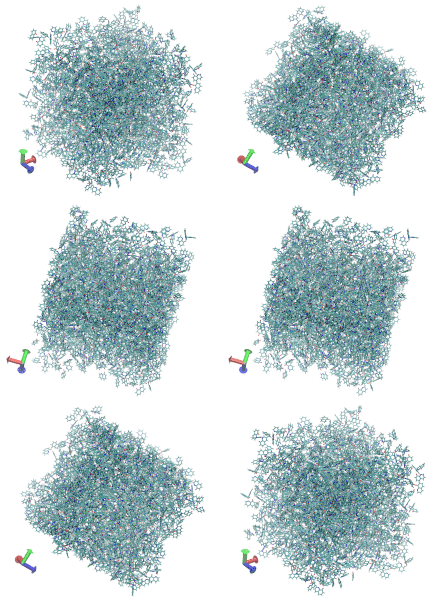
This paper presents a novel experimental perspective on spin and charge dynamics in high-mobility polymers, supported by calculations of the spin admixture distribution in realistic, large-scale polymer morphology models performed by the OST.
A joint publication by the Organic Spintronics Team and other ERC Synergy Project collaborators has been published in Nature Electronics. This paper presents experimental measurements of extremely long spin diffusion lengths in high-mobility organic polymer materials.
Modeling by the Organic Spintronics Team explains this finding in terms of the weak up-down spin mixing found in planar conjugated polymers with weak spin-orbit coupling.
In many areas of solid state technology (e. g. photonics and photovoltaics), efforts are underway to replace traditional semi-conductor materials with components based on organic molecules. While generally aiming for cheaper industrial production, more abundant raw materials and significantly greater tailorability and versatility of materials, molecular materials science has already produced a number of unique and superior technologies, such as OLED-based displays in smartphones. Organic spintronics seeks to bring these advantages to the field of spintronics. Our team makes up the theory node in an interdisciplinary collaboration funded by a Synergy Grant awarded by the European Research Commission (ERC).
From Single Molecules to Realistic Material Models
Collaborating closely with experimentalists, we seek high-quality predictions and maximal complementarity in our theoretical modeling. We try to understand spin dynamics in realistic material models, from the interactions of single electrons all the way up to meso-scale ensemble effects in molecular materials, without resorting to empiricism or oversimplification. We achieve this using a wide range of techniques from first-principles theory, chiefly density functional theory (DFT), DFT perturbation and -response theory, and tight-binding Hamiltonians. We go from studying small systems in great detail to semi-classical models of large systems, mainly using kinetic Monte Carlo (KMC), while tying all the various size-, time- and energy-scales together in so-called multi-scale modeling.
We employ a number of electronic structure theory software packages such as NWChem, ORCA, DIRAC, SIESTA, and Quantum ESPRESSO. For state-of-the-art electron dynamics in soft matter, we use the multi-scale modeling VOTCA toolkit, with which we are developing a unique extension for spin dynamics in organic materials, VOTCA-STP.
Team
The ERC Synergy Grant and Other Collaborations
We have the great fortune of closely collaborating with several of the leading groups in our field(s).
Within the Synergy Grant, we collaborate with the groups of
Antiferromagnetic spintronics is a new rapidly developing field whose focus is the manipulation of antiferromagnets with electrical current. Antiferromagnets are promising materials for spintronic applications as they are fast, nonvolatile, and robust with respect to external fields. They can be manipulated by spin and charge currents. Their complex structures, strong magnetoelastic coupling, and compatibility with technologically important semiconductors make antiferromagnets interesting materials and open a way for new functionalities in comparison with ferromagnetic materials.
Our research interest focuses mainly on theoretical investigations of
Spin-current induced magnetic dynamics in anti- and ferrimagnets with antiferromagnetic coupling between the magnetic sublattices
Ultrafast antiferromagnetic dynamics induced by femtosecond optical pulses
Kinetics and transport properties of antiferromagnets in the presence of spin currents and/or temperature gradients
Topological properties of antiferromagnets, Dirac and Weil semimetals
The possibility of tuning topological properties with spin currents
To build a bridge between hard-core theoretical calculations and experimentalists we utilize phenomenological approaches.
We work in close cooperation with experimental groups